
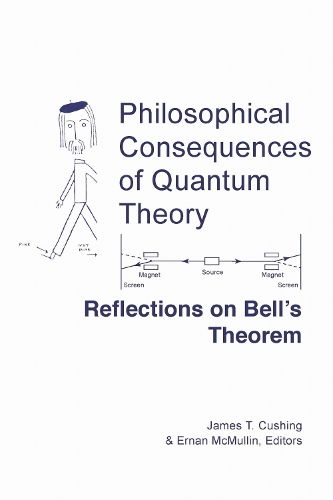
Philosophical Consequences of Quantum Theory – Reflections on Bell`s Theorem
Philosophical Consequences of Quantum TheoryReflections on Bell's Theorem\nAuthor(s): James T. Cushing, Ernan McMullin\nFormat: Paperback\nPublisher: University of Notre Dame Press, United States\nImprint: University of Notre Dame Press\nISBN-13: 9780268015794, 978-0268015794\nSynopsis\nFrom the beginning, the implications of quantum theory for our most general understanding of the world have been a matter of intense debate. Einstein argues that the theory had to be regarded as fundamentally incomplete. Its inability, for example, to predict the exact time of decay of a single radioactive atom had to be due to a failure of the theory and not due to a permanent inability on our part or a fundamental indeterminism in nature itself.\n\n In 1964, John Bell derived a theorem which showed that any deterministic theory which preserved \""locality\"" ([url] which rejected action at a distance) would have certain consequences for measurements performed at a distance from one another. An experim.
Compare prices (4 shops)
| shop | Price | Action |
|---|---|---|

|
19,30 GBP | Go to shop |
|
|
20,79 GBP | Go to shop |
|
|
22,76 GBP | Go to shop |
|
|
36,54 GBP | Go to shop |