
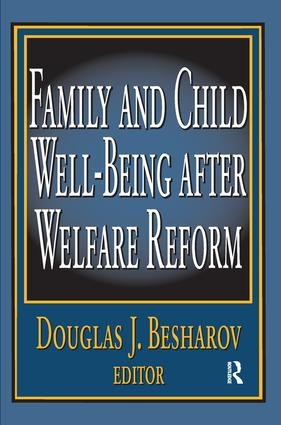
Family and Child Well-being After Welfare Reform
Taylor & Francis
Since their historic high in 1994, welfare caseloads in the United States have dropped an astounding 59 percent--more than 5 million fewer families receive welfare > \nSince their historic high in 1994, welfare caseloads in the United States have dropped an astounding 59 percent--more than 5 million fewer families receive welfare. Family and Child Well-Being after Welfare Reform, now in paperback, explores how low-income children and their families are faring in the wake of welfare reform. Contributors to the volume include leading social researchers. Can existing surveys and other data be used to measure trends in the area? What key indicators should be tracked? What are the initial trends after welfare reform? What other information or approaches would be helpful? The book covers a broad range of topics: an update on welfare reform (Douglas J. Besharov and Peter Germanis); ongoing major research (Peter H. Rossi); material well-being, such as earnings, benefits, and consumption (x
Compare prices (1 shop)
| shop | Price | Action |
|---|---|---|

|
103,99 GBP | Go to shop |